
By PaisaKawach Team | August 30, 2025
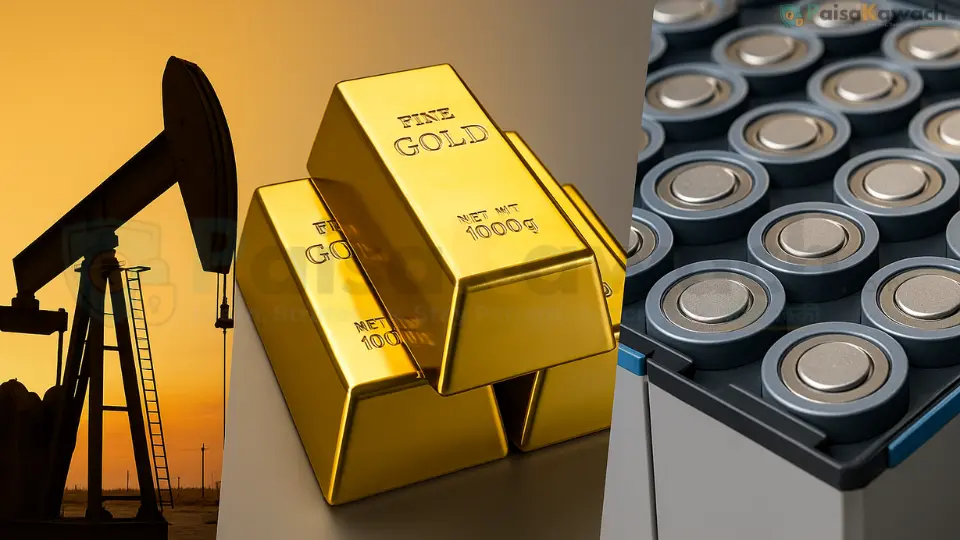
Every era of human progress has been defined by its essential resources. During the industrial age, coal and steel laid the foundation of modern economies, building railroads, factories, and empires. In the 20th century, oil emerged as the undisputed energy backbone of nations, while gold provided financial systems with a sense of trust and long-term value. Today, as the world steps deeper into the 21st century, a new contender has joined the ranks: lithium, the “white gold” that powers smartphones, electric cars, renewable energy storage, and the broader global clean energy transition.
To understand the modern economy, one must understand commodities. Among hundreds of raw materials traded globally, three stand out for their unmatched influence—oil, gold, and lithium. Together, they fuel industries, shape geopolitics, secure national power, and define the pace of technological innovation. This article takes a deep dive into why these three commodities drive the world economy and why they will continue to do so in the decades ahead.
Commodities are the raw building blocks of global trade. They are not merely items we consume in daily life—they are inputs for nearly every product, service, and infrastructure around us. Economists often call them the “DNA of the economy,” because shifts in commodity prices ripple across sectors, impacting inflation, trade, and political stability.
History repeatedly shows that access to resources is synonymous with power. From the spice routes of the medieval period to the OPEC oil embargo of the 1970s, commodities have been central to how nations rise and fall.
For over a century, oil has been the single most important commodity in the world. It powers cars, planes, shipping routes, and entire military machines. More than 90 million barrels are consumed daily worldwide. No other commodity integrates so deeply into both civilian life and strategic defense. From fueling logistics networks to manufacturing petrochemicals used in plastics, fertilizers, and pharmaceuticals, oil remains indispensable.
The price of oil acts like a thermometer for global economic health. Rising oil prices often stoke inflation, raise transportation costs, and squeeze household budgets. Conversely, lower oil prices may reduce consumer expenses but can destabilize oil-exporting nations such as Saudi Arabia, Russia, or Venezuela.
Case studies prove this dynamic. The 1973 OPEC oil embargo triggered a global recession. In 2008, oil soared to $147 per barrel before collapsing during the financial crisis. In 2020, oil briefly turned negative due to collapsing demand during the COVID-19 lockdowns. These episodes highlight the commodity’s volatility and its ability to influence every layer of the economy.
Oil has been at the heart of countless global conflicts—from Middle Eastern wars to sanctions targeting major producers. Control over reserves often translates into political leverage. Organizations like OPEC+ continue to coordinate production cuts or increases, reminding the world that supply management remains a tool of geopolitical power even in 2025.
While renewable energy and electric vehicles are steadily reducing dependence on oil, the transition will take decades. Petrochemicals derived from oil are still vital for plastics, fertilizers, paints, and medicines. According to the International Energy Agency (IEA), oil demand growth may plateau by 2030, but it will remain a cornerstone of the energy system for decades. The challenge ahead is managing a responsible decline without triggering energy shortages or economic shocks.
Unlike oil, gold is not consumed—it is stored. For thousands of years, civilizations have hoarded gold as a measure of wealth, prestige, and financial stability. Ancient empires minted coins, kings stored it in vaults, and today central banks hold over 35,000 tonnes of gold in reserves. Its value lies in scarcity, durability, and universal acceptance.
Gold’s biggest power lies in psychology. It represents safety when the world feels uncertain. Whether it’s war, inflation, or fears of recession, investors flock to gold because it retains value when currencies and stock markets wobble.
For instance, during the 2008 global financial crisis, gold prices surged as equities collapsed. Similarly, during the COVID-19 pandemic, gold touched record highs above $2,000 per ounce, reinforcing its role as the world’s safety net.
Gold has a unique inverse relationship with the U.S. dollar. When the dollar weakens, gold prices typically rise, and vice versa. This dynamic adds complexity to trade and investment strategies, especially for emerging markets reliant on U.S. currency strength.
Even in 2025, gold plays a vital role in investment strategies. Financial advisors typically recommend allocating 5–10% of portfolios to gold as a hedge against volatility. Beyond bullion, investors now access gold through ETFs, mining stocks, and even digital tokens, showing how a centuries-old asset has adapted to modern finance.
If oil powered the 20th century, lithium is powering the 21st. Lithium-ion batteries are the backbone of modern technology—driving electric vehicles (EVs), renewable energy storage, and everyday electronics like smartphones and laptops. Without lithium, the world’s clean energy and decarbonization goals would stall.
By 2030, more than 60% of new cars sold globally are projected to be electric. Each EV battery requires between 10–60 kilograms of lithium, depending on its size. This skyrocketing demand has turned lithium into a strategic resource. Countries like Chile, Australia, and Argentina, which hold some of the world’s largest reserves, now find themselves at the center of the global energy transition.
Just as oil-rich nations wielded power in the 20th century, lithium-rich nations are gaining leverage in the 21st. China dominates lithium refining and battery production, creating concerns in the U.S. and Europe about supply chain dependency. Governments are now scrambling to secure lithium through trade deals, investments, and strategic stockpiles, much like the geopolitics of oil in decades past.
While lithium demand is booming, its extraction presents environmental challenges. Mining is water-intensive and often damages fragile ecosystems, especially in South America’s salt flats. To balance growth with sustainability, recycling of used batteries and the search for alternatives like sodium-ion technology are becoming urgent global priorities.
While different in nature, oil, gold, and lithium share one undeniable trait: they act as levers of global power.
Each commodity represents a different timeline of human progress—oil reflects the 20th century, gold reflects timeless value, and lithium represents the future. Together, they are shaping how economies adapt to a multipolar, fast-changing world.
For investors, oil, gold, and lithium represent not just commodities but entire economic cycles. Diversification across these assets helps hedge risks while capturing opportunities in energy, technology, and finance. Oil investments remain tied to energy majors and futures, gold is accessed via bullion and ETFs, while lithium plays out through mining companies and EV-focused funds.
The future global economy will continue to be shaped by commodities. Oil may plateau but will not disappear; it will remain essential for aviation, shipping, and petrochemicals. Gold will continue to act as a universal safety net, especially as digital currencies rise and trust becomes even more fragile. Lithium, meanwhile, is only at the beginning of its story, with demand expected to triple by 2040.
Beyond these three, new commodities are emerging. Rare earth metals, hydrogen, and uranium are gaining importance, hinting at the next generation of strategic resources. Yet, for now, oil, gold, and lithium remain the undisputed cornerstones of the world economy.
Commodities are more than numbers on a trading screen. They are the hidden forces shaping our daily lives, guiding national strategies, and defining global futures. Oil ensures energy security, gold anchors trust, and lithium powers innovation. Understanding these commodities is not just for economists or traders—it is essential knowledge for anyone who wants to grasp how the world truly works.
 Stable vs Trend-Catching Businesses: Which Model is Truly Sustainable in 2025 and Beyond?
Next →
Stable vs Trend-Catching Businesses: Which Model is Truly Sustainable in 2025 and Beyond?
Next →
 Patience Pays: How 10 Years in the Market Outshines 10 Days of Trading
No comments yet. Be the first to comment!