
By PaisaKawach Team | September 2, 2025
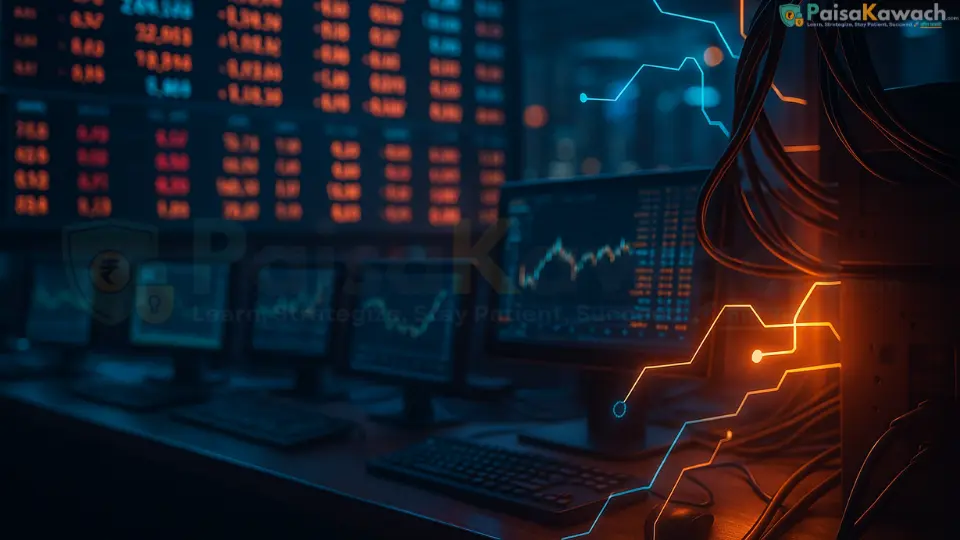
When most people think of stock markets, they picture charts, numbers, and traders shouting buy or sell orders. But beneath the surface lies a hidden lifeline without which no trade, no ticker, and no financial pulse could exist: electricity and the internet. Without these forces, the global stock market would collapse into silence. They are not simply tools — they are the beating heart that keeps modern exchanges alive.
Stock exchanges did not always rely on digital infrastructure. In the late 18th and early 19th centuries, exchanges like the New York Stock Exchange operated entirely through face-to-face communication. Human messengers, telegraphs, and ticker tape carried the lifeblood of information. Electricity powered telegraphs in the mid-1800s, shrinking time and distance, but the true revolution came much later with computers and networks.
The ticker tape, introduced in the 1860s, was the first technology-driven heartbeat of markets. It relied on electricity to print real-time prices onto long rolls of paper. This was the first step in connecting finance with electrical power, making markets move faster than human messengers ever could.
Today’s markets cannot exist without electricity. Data centers hum with the sound of servers processing millions of orders every second. Every trade, every order book, every chart on your mobile app is powered by electrical currents flowing through hardware. Exchanges are built on redundant grids to ensure the “pulse” never stops, even if one circuit goes down.
If electricity is the heartbeat, then the internet is the oxygen that allows markets to breathe. Exchanges are now globally interconnected. When New York closes, Tokyo is already awake, and when Tokyo rests, London takes the baton. This cycle never ends, and the internet ensures that information flows seamlessly across continents in real-time.
The rise of electronic trading platforms in the 1990s democratized markets. Suddenly, a retail investor sitting at home with an internet connection could place an order once reserved for professional brokers. The heart of finance expanded beyond physical walls and trading floors, pumping opportunity directly into living rooms.
Despite their resilience, stock exchanges have faced moments when the “heartbeat” faltered. Blackouts, cyberattacks, and internet outages have triggered trading halts worldwide. These incidents reveal just how dependent global finance is on invisible flows of power and data.
The next wave of stock market evolution comes from artificial intelligence and quantum computing. Algorithms now make split-second decisions across markets, fueled by streams of real-time data. But this also means exchanges depend even more on uninterrupted electricity and flawless internet connectivity. The stronger the heartbeat, the more devastating it is when it falters.
While AI enhances efficiency, it also magnifies systemic risks. A failure in one region can ripple across global markets instantly. The more we rely on digital oxygen, the greater the need to protect it.
Stock exchanges are not just financial institutions; they are massive technology companies. Their electricity bills run into millions of dollars annually. Data centers require constant cooling, redundancy systems, and backup generators. Internet infrastructure — from undersea cables to 5G towers — represents an ongoing investment. The business of keeping markets alive is itself a billion-dollar industry.
For most investors, power grids and internet lines seem irrelevant. But every portfolio, every trade, and every retirement account depends on them. A single glitch can change the course of a trading day, wiping out billions in value. Awareness of this hidden infrastructure gives investors a new lens for risk management.
Smart investors consider not only financial indicators but also technological resilience. Companies that control or secure critical internet and electricity infrastructure may become the most valuable players in tomorrow’s financial markets.
Behind every glowing chart, every bullish rally, and every bearish crash lies a heartbeat powered by electricity and the internet. Markets are not abstract entities; they are living systems built on wires, circuits, and global connections. To understand the stock market fully, one must look not only at numbers but also at the invisible lifelines that keep those numbers moving.
 How Global Inflation Shapes Business Pricing Strategies in 2025: Key Insights for Companies
Next →
How Global Inflation Shapes Business Pricing Strategies in 2025: Key Insights for Companies
Next →
 Why Do Prices Go Up? Inflation Explained with Pizza and Ice Cream