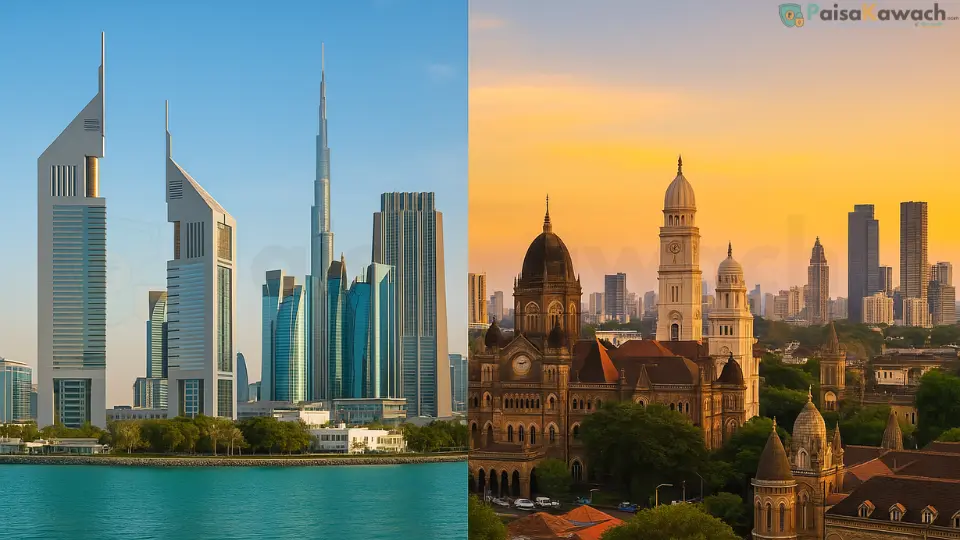
India and the United Arab Emirates announced an ambitious goal this week: lift bilateral trade in goods and services — excluding oil and precious metals — to $100 billion in the next three to four years. The target was set during the 13th meeting of the India-UAE High-Level Joint Task Force on Investments, co-chaired by India’s Commerce Minister Piyush Goyal and senior UAE investment chiefs.
Where the numbers stand today
At present, non-oil, non-precious-metal trade between India and the UAE is estimated at roughly $50–55 billion annually. The first half of 2025 itself recorded nearly $38 billion — a jump of about 34% year-on-year — signaling strong momentum coming out of the Comprehensive Economic Partnership Agreement (CEPA) enacted in 2022. The new target therefore requires roughly doubling existing non-oil flows within a short policy horizon.
How realistic is the target?
- Short answer: Challenging but feasible — if both sides coordinate policy, unlock investments, and scale trade infrastructure quickly.
- Why feasible: the UAE already plans large capital allocations to non-oil sectors and has signalled interest in significant investments in India’s stock market and infrastructure, while India is pushing export diversification and supply-chain resilience.
- Why challenging: doubling trade in 3–4 years requires average annual growth rates well above historic norms, rapid removal of non-tariff barriers, faster logistics upgrades and concrete private-sector commitments.
Which sectors will drive the growth
Several high-potential segments can deliver the bulk of the incremental trade:
- Manufacturing & Electronics: Components, consumer electronics and capital goods for the Gulf and Africa via UAE hubs.
- Agri & Processed Foods: Value-added food products, packaged foods and specialty ingredients that match GCC demand patterns.
- Pharma & Health Tech: Exports of generics, medical devices and tele-health services.
- Renewable Energy & Green Tech: Solar components, EV supply chain items and project services — aligning with the UAE’s green transition plans.
- Logistics, Warehousing & Data Centres: UAE investment in Indian logistics and data infrastructure can deepen trade flows and lower friction.
- Services & Financial Flows: IT/ITeS, professional services, fintech partnerships and portfolio flows into Indian markets.
Policy levers and partnerships on the table
Officials and industry leaders discussed practical levers to hit the target:
- Joint infrastructure projects: Co-development of housing, logistics corridors and industrial parks in third countries — using UAE capital and Indian contractors. (Source: official HLTFI communiqués.)
- Investment routes: UAE sovereign and private investors considering large scale stock purchases and increased direct investment into Indian platforms: green energy, data centres and fintech.
- Trade facilitation: Faster customs clearance, digital documentation, and targeted trade promotion campaigns like buyer-seller meets and sectoral roadshows.
- SME support: Platforms (public and private) to integrate Indian SMEs into UAE supply chains — including dedicated e-marketplaces and credit lines.
What this means for exporters, investors and policymakers
Exporters: Firms that can meet Gulf quality, packaging and delivery timelines stand to benefit first. Niche producers of processed foods, specialty chemicals, leather goods, textiles and consumer durables should prioritize UAE distribution partners and compliance upgrades.
Investors: UAE capital can accelerate India’s infrastructure upgrades — especially logistics, warehousing and renewable projects. Indian firms that partner with UAE investors to build overseas hubs (Africa, GCC) can expand re-export volumes.
Policymakers: Rapid approvals for joint projects, a practical roadmap to lower trade frictions, and sectoral memoranda of understanding can make the pace required to hit $100bn credible.
Risks and friction points
- Geopolitical uncertainty: Gulf politics, shipping route risks and sanctions regimes remain wildcard factors that can disrupt timelines.
- Logistics & capacity bottlenecks: Ports, cold chains and customs processes need meaningful upgrades to handle doubled volumes.
- Regulatory alignment: Divergent standards (safety, food, technical) across markets require harmonization or mutual recognition.
- Overreliance on a few categories: Achieving sustainable $100bn means diversification across many sectors, not concentration in a handful of products.
Timeline: what to watch over the next 12–18 months
- Q4 2025 – concrete project announcements and investment MOUs from UAE sovereign and private investors.
- 2026 – scale-up of logistics capacity, special trade corridors and increased re-exports to Africa and GCC via UAE hubs.
- 2027–2028 – measurable increases in sectoral exports (renewables, electronics, food processing) and continuing portfolio and direct investments into India.
Final take — opportunity with a deadline
The $100 billion non-oil trade target is both a strategic signal and a practical challenge. It underlines how India and the UAE see each other: not merely as suppliers and buyers, but as long-term partners for capital deployment, regional infrastructure and service-led trade. For Indian exporters and startups, the opportunity is immediate — align product standards, secure UAE distribution partnerships and prepare to scale. For investors, the UAE’s capital can unlock capacity that speeds the trajectory. For policymakers, the task is to turn the target into an operational roadmap with clear milestones and accountability.